

Key Features | Prompt-to-UI, visual + AI editing, Figma integration, MCP |
Pros | Strong design-system fidelity, clean code export for free |
Cons | Credits burn fast on small AI edits, patchy screenshot-to-UI |
Pricing | Free (100 credits/mo); Starter $20/seat/mo (1,000 credits) |
Alternatives |
My Figma Agent (Config 2026) Review Summary >
What is Magic Patterns?
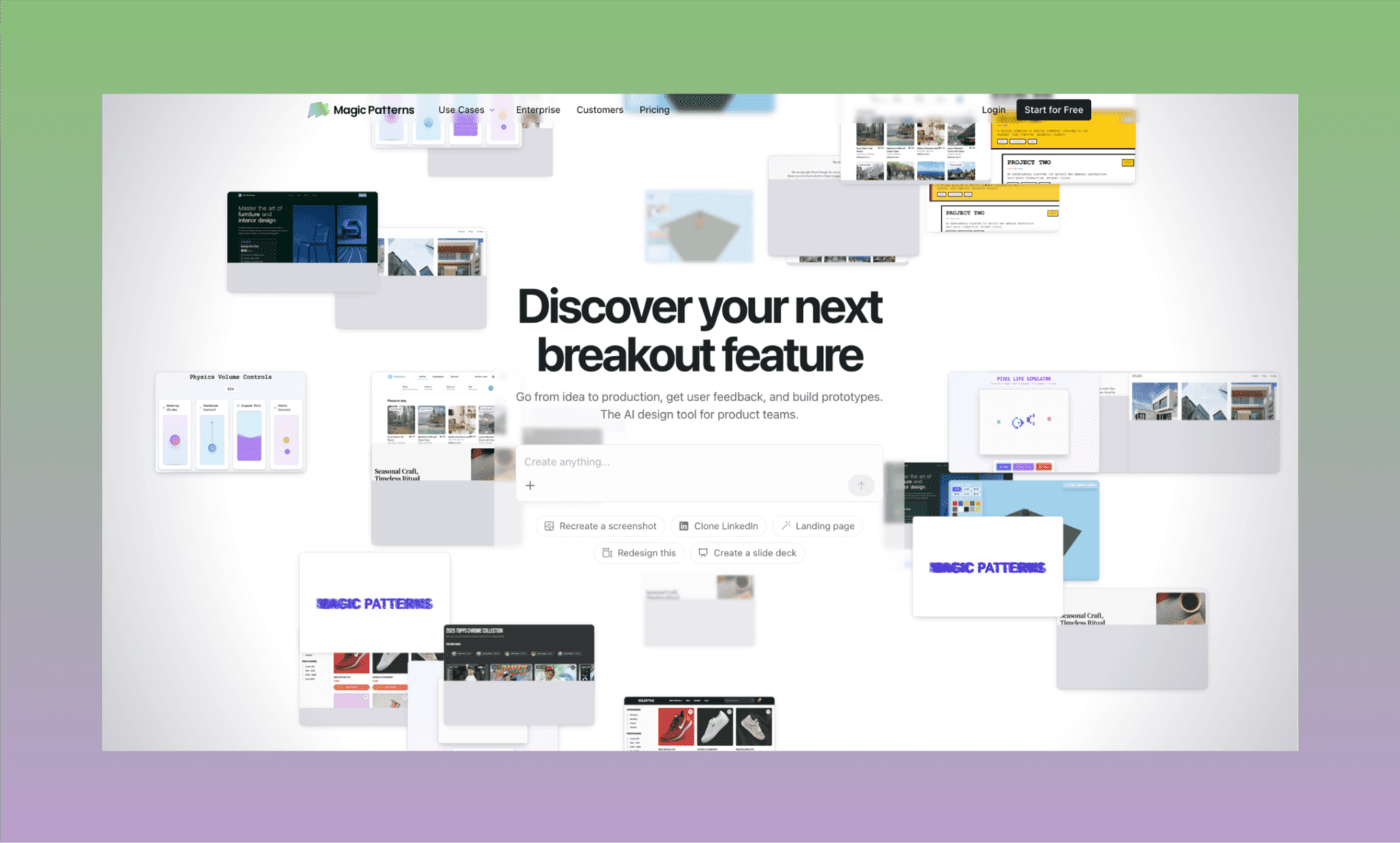
Magic Patterns is an AI-native design platform that turns text/image prompts into production-ready UI screens and code[1]. It caters to product teams to assist at each stage, from ideation to deployment.
Founded in late 2023 by Alex Danilowicz and Teddy Ni, its latest version is Magic Patterns 2.0.[2]
Top 9 Magic Patterns Competitors Compared >
My Experience with Magic Patterns AI
To review the core capabilities of the Magic Patterns app design builder, I plan to create a simple mobile productivity app from prompts, make edits, add screen(s), and look around for any magical features.
Sign up and select a starting point
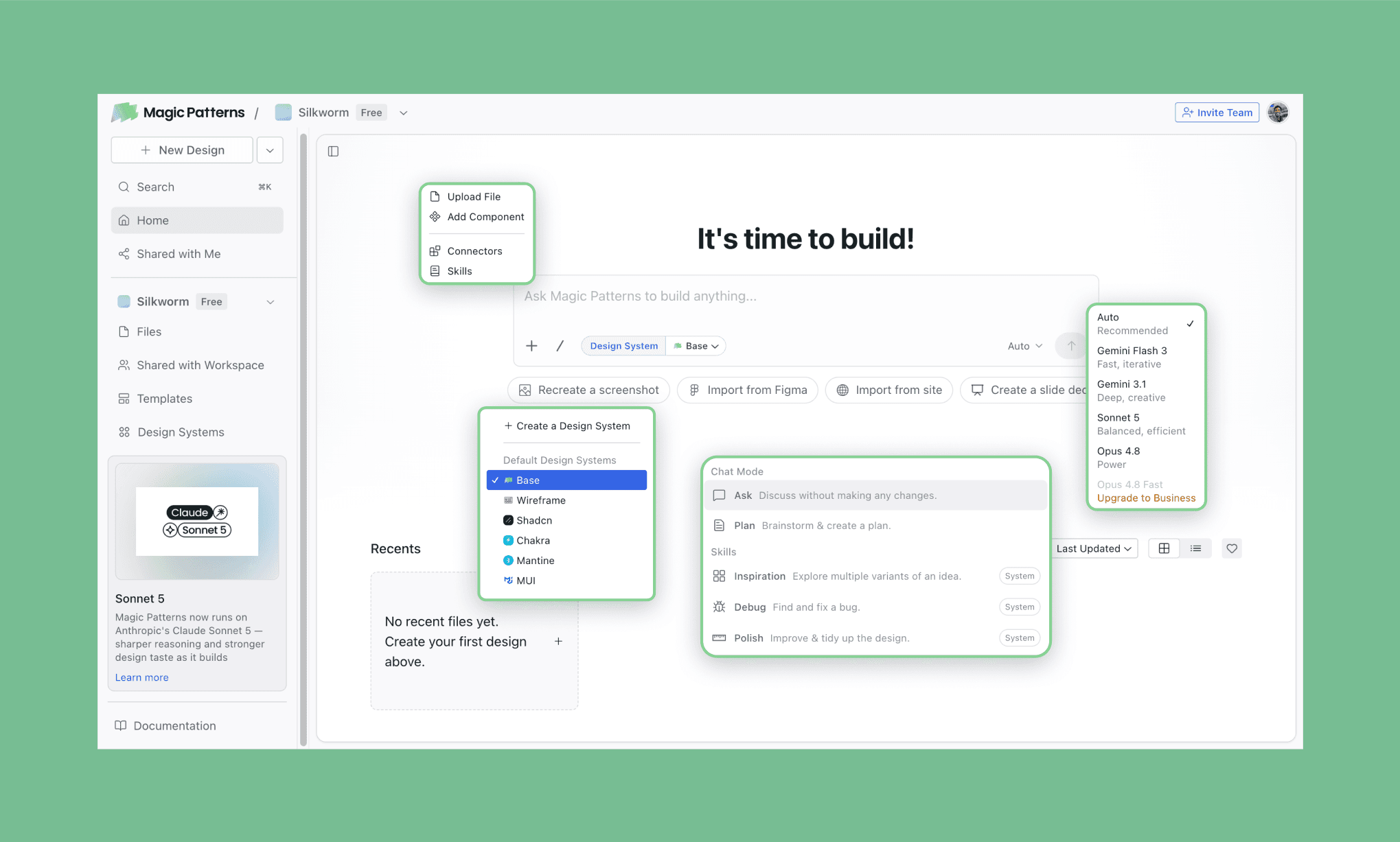
Signing up or logging in to Magic Patterns is straightforward, free, and requires no credit card. The portal’s homepage has a welcoming prompt box with a variety of options to start your prototyping:
Upload a file (UI reference or PRD), design system, connector, or skill
Use the default Magic Patterns design system or classic Shadcn, MUI, etc.
Chat with AI to design UI, plan, debug, or polish
Choose AI models: Gemini 3.1, Flash 3, or Claude’s Sonnet 5 or Opus 4.8
Build a wireframe, recreate a screenshot, import from Figma, and others
Prompt-to-UI
Plenty of directions to start with, and we’ll touch upon those, but sticking to our agenda, we test out Magic Patterns prompt-to-UI first:
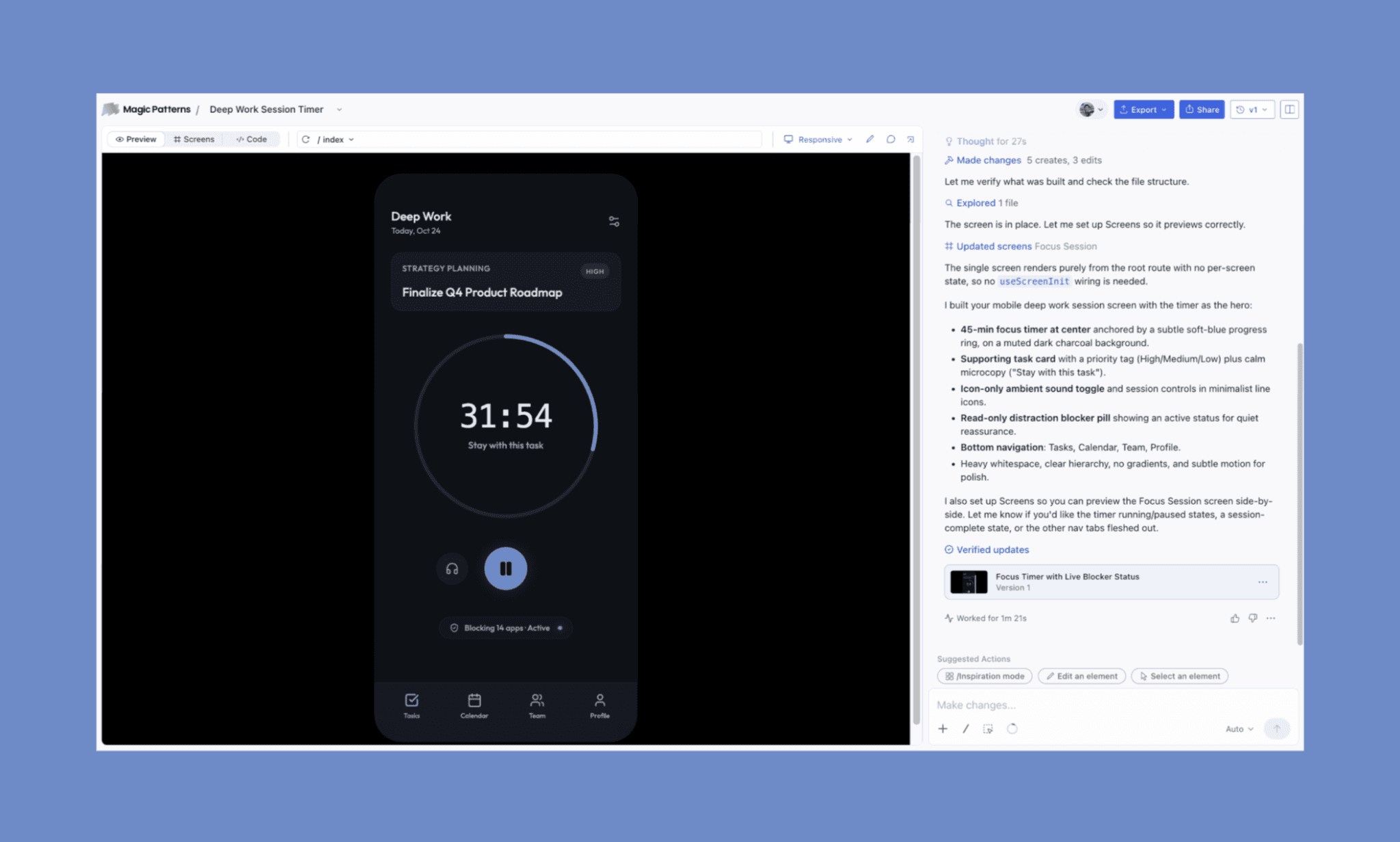
"Design a mobile productivity app screen for deep work sessions. Use a muted dark theme with soft blue accents. Include a task card with priority tags (High/Medium/Low), a 45-min focus timer, an ambient sound toggle (icon-only), and a visible distraction blocker status. Add a subtle progress ring, minimalist line icons, and calm microcopy (“Stay with this task”). Bottom navigation: Tasks, Calendar, Team, Profile. Prioritize whitespace and clear visual hierarchy."
*Note: I created the same app, with the exact same prompt, using its competitors for a fair comparison. Check out the Magic Patterns competitors' design >
The AI design agent asked clarifying questions, took ~3:30 mins, and consumed 35 credits to produce the first draft. It is neat, minimalist, and includes micro-interactions. In fact, the UI generation is a proper AI prototype by Magic Patterns. Impressive!
And, it offers three view modes: Preview with one screen focus, Screens to see all screens in one infinite canvas, and Code to see & edit full React + TypeScript project (Vite-style), styled with Tailwind. One drawback here, though, is that its responsive preview is not really that great when switching from desktop to mobile.
Create multiple screens following a Design System
The single-screen output is decent, but for it to be a full-fledged app prototype, Magic Patterns should expand it to a multi-screen UI. I know I could prompt it, but this time I decided to add a design MD file of ‘Nintendo 2001’ retro look to check how closely it can follow a design system.
“Using the attached Nintendo.com (2001) design system, expand this into a connected 4-screen app: Tasks (existing Focus Session screen), Calendar, Team, and Profile. Wire up the bottom nav so all four tabs work and link between screens.
Calendar: view of upcoming and past focus sessions.
Team: see teammates' current focus status.
Profile: session stats, streaks, and account settings.
Keep the existing Tasks screen's functionality (timer, task card, ambient toggle, distraction blocker) but restyle it to match the attached design system.”
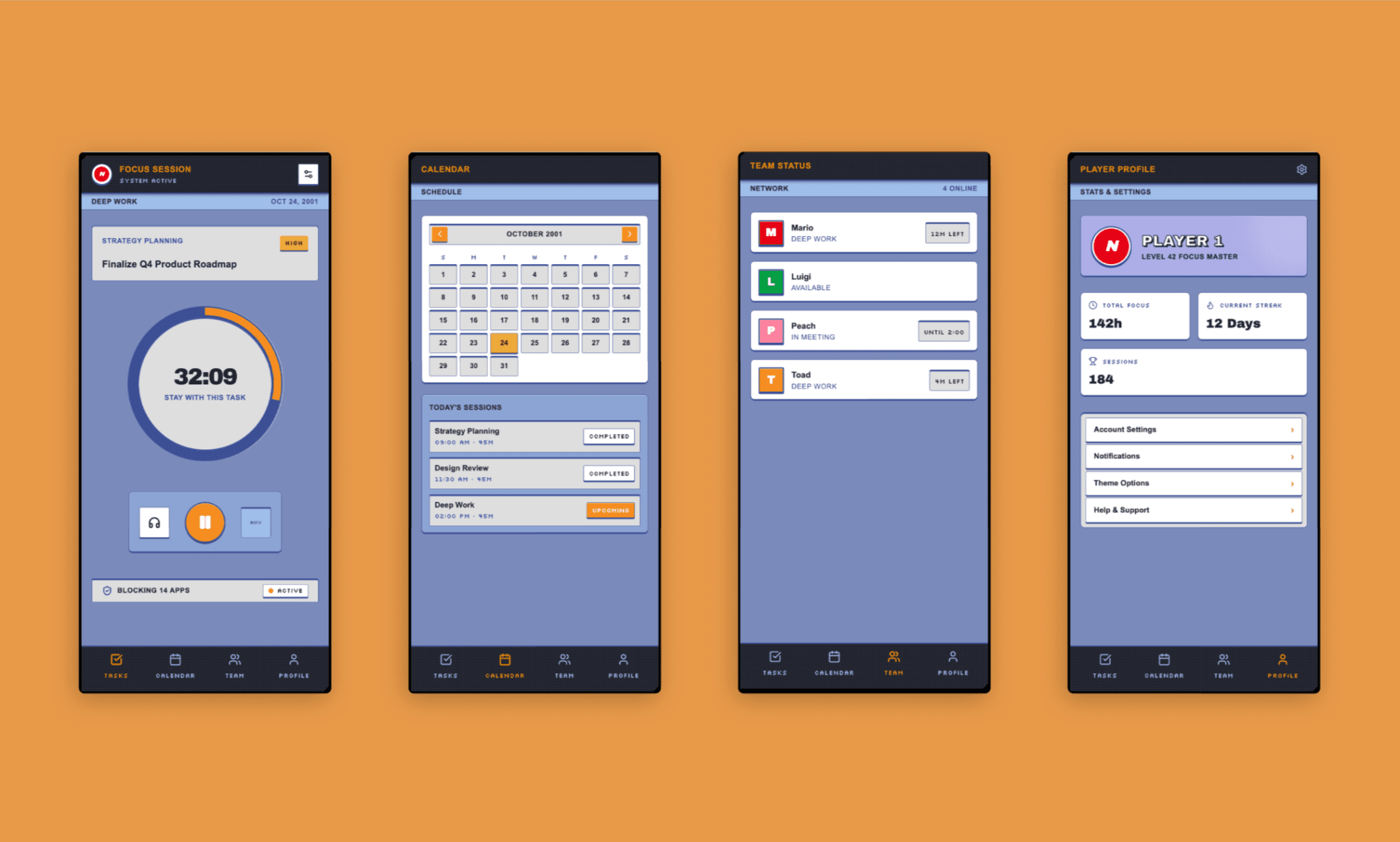
It processed on my prompt and file and produced a classic Nintendo-style connected screen, exceeding my expectations; taking around 5 minutes and 60 credits.
The micro-interactions of hover states and animated appearance are there, but the dropdown and toggles are not working at it would if Lovable or Figma Make were working on it. I wouldn’t be too critical on this miss, though.
Generate Multi-screen UI with AI >
Editing manually and with AI
UI design is iterative, and Magic Patterns offer two editing methods: Visual edit and AI edit.
i) Visual edit
In Magic Patterns IDE, above the UI section, you can click the pencil icon to switch to ‘Visual Edit’ mode. It is basically a Figma-like point-and-edit canvas. Manually, I removed all text from the header and changed the sub-header to match the nav-bar title in all screens.
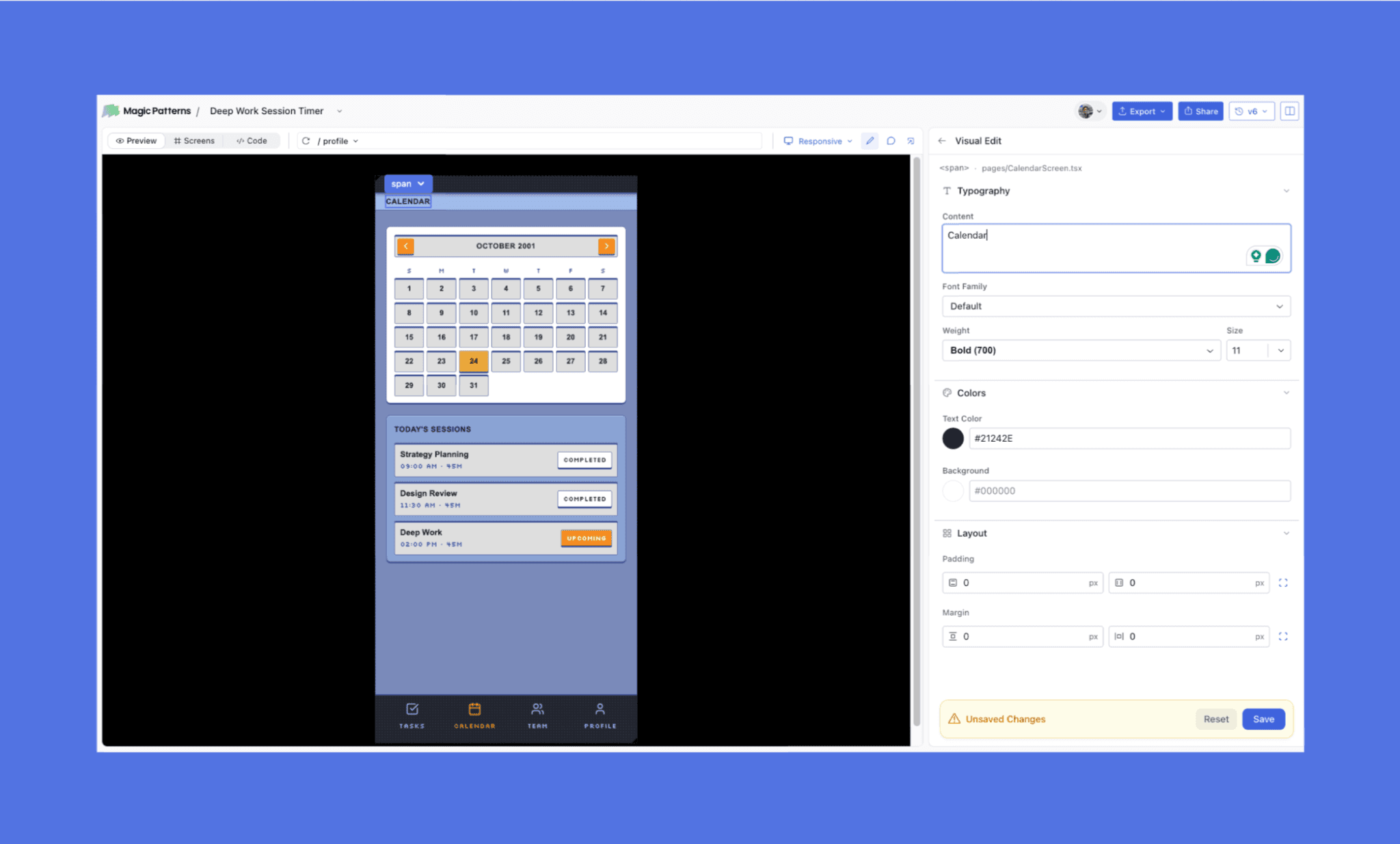
Visual edits cost no credits in Magic Patterns and are almost as smooth as editing a Figma design file. I say almost because most of the time you select elements on the left side, but make the changes from the settings on the right side.
ii) AI edit
I had cleared out the headers in all screens because I wanted them all to be the same: logo + wordmark. I created the logo using a Weave Tool inside Figma design (announced in Config 2026 for Figma AI) and asked the AI to come up with a name and suitable wordmark in 8-bit style to assess Magic Patterns design intelligence.
“Using the attached hourglass icon, come up with a fitting app name and design an 8-bit style wordmark to pair with it. Apply this logo + wordmark as the header on all four screens (Tasks, Calendar, Team, Profile) — keep it consistent across every screen.”
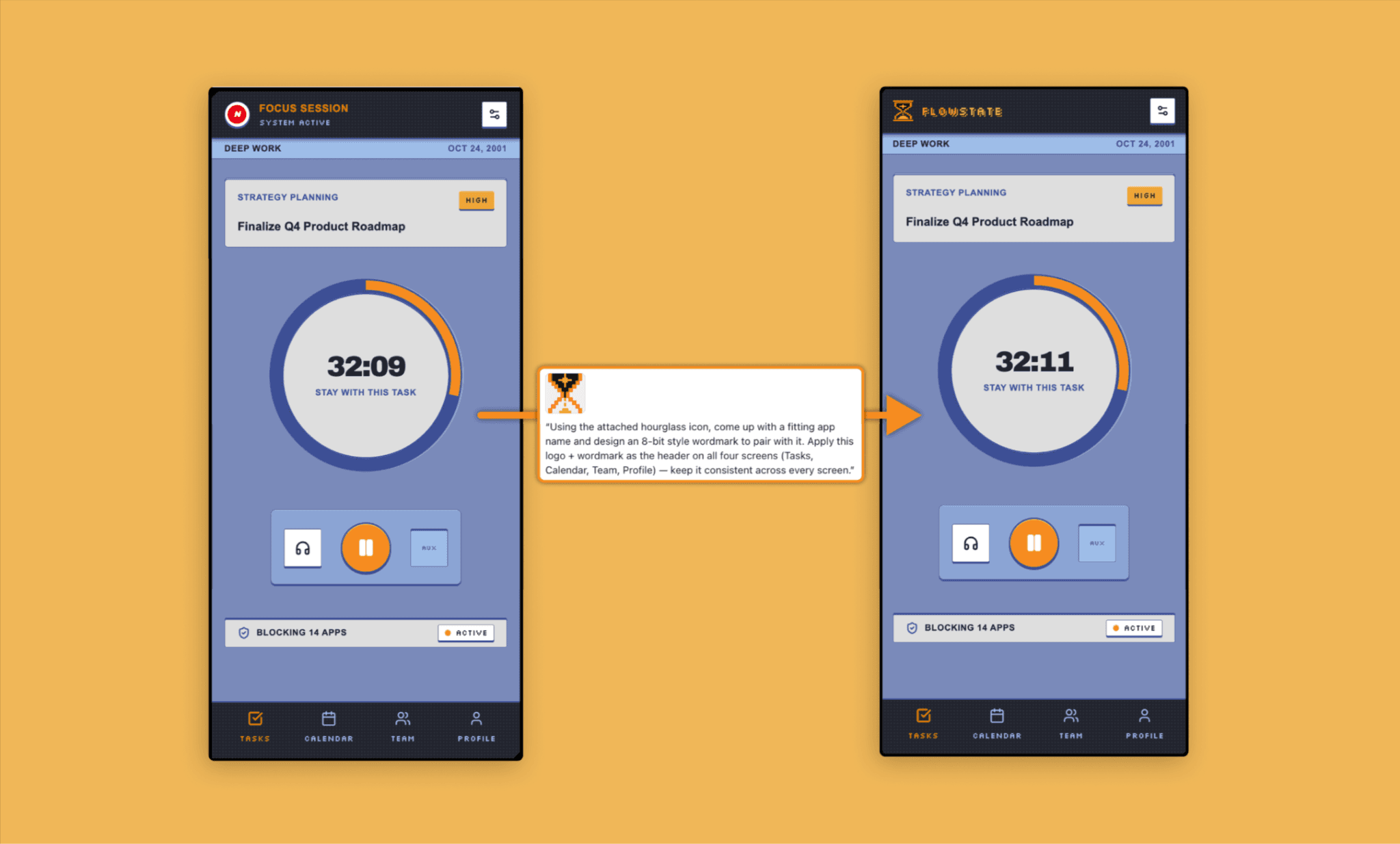
AI edits, of course, cost credits in Magic Patterns and, in my case, consumed ~60 credits, took ~2 minutes, and did the task as expected. All screen headers are changed to the logo I had given, and it chose the name ‘Flowstate’, written in 8-bit style. However, I felt the logo was recreated to match my original one, and the name it chose is generic. But more concerning is that it ate up too many credits for a small edit, as much as if recreating the whole 4 screens.
Magic Patterns - Figma export/import
The Magic Patterns Figma plugin has a simple proposition: create a design in Magic Patterns and export to Figma for the product team. (However, in 2026, I suppose it’ll be challenged by Figma’s own in-canvas AI Design Agent). On the flip, we know that static Figma frames can themselves be imported to Magic Patterns to be edited/referenced with AI.
The Magic Patterns plugin for Figma works with a layer ID generated by the former; however, during my test, I could not find any such thing in their IDE.
But the workflow is not lost; it is instead even smoother.
Magic Patterns to Figma
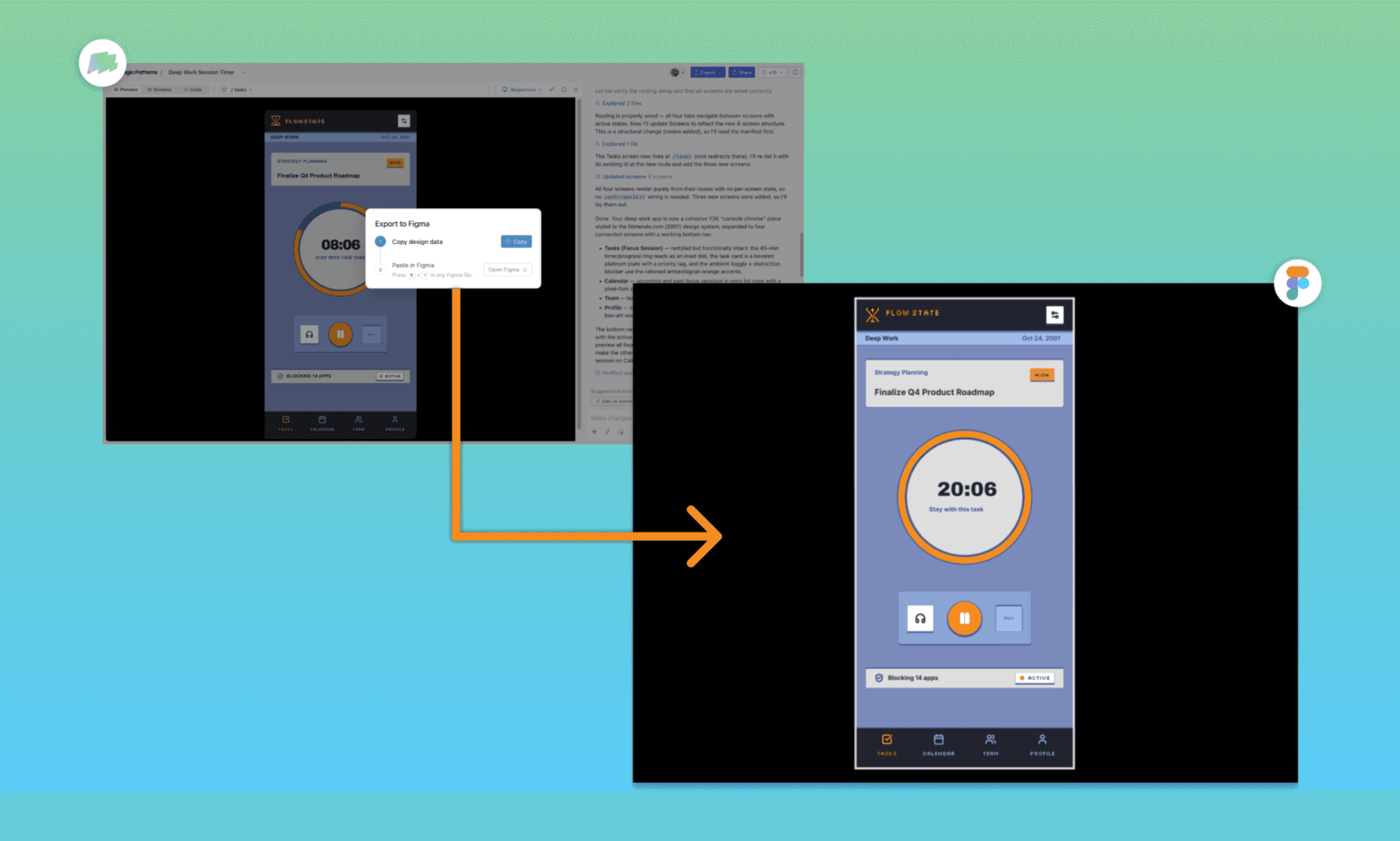
The Magic Patterns IDE has an ‘Export’ button on the header, with Figma as an option. Open it, click copy, open a Figma design file, and paste it. That’s it. The whole of the screen is imported to Figma with the background and fully editable.
Although there could be minor design mutations when importing.
Figma to Magic Patterns
Select a frame in your Figma file, copy it (like regular CTRL/CMD+C), and just paste it in an existing chat of Magic Patterns or in a new project prompt – ask away what to do with it. It’ll ask for authorization that connects the two tools in seconds.
For instance, I created a variation of the profile page of our app using Figma Agent, copied the frame, pasted in my running chat of the Deep Focus Timer app in Magic Patterns, and asked it to replace the existing Profile page.
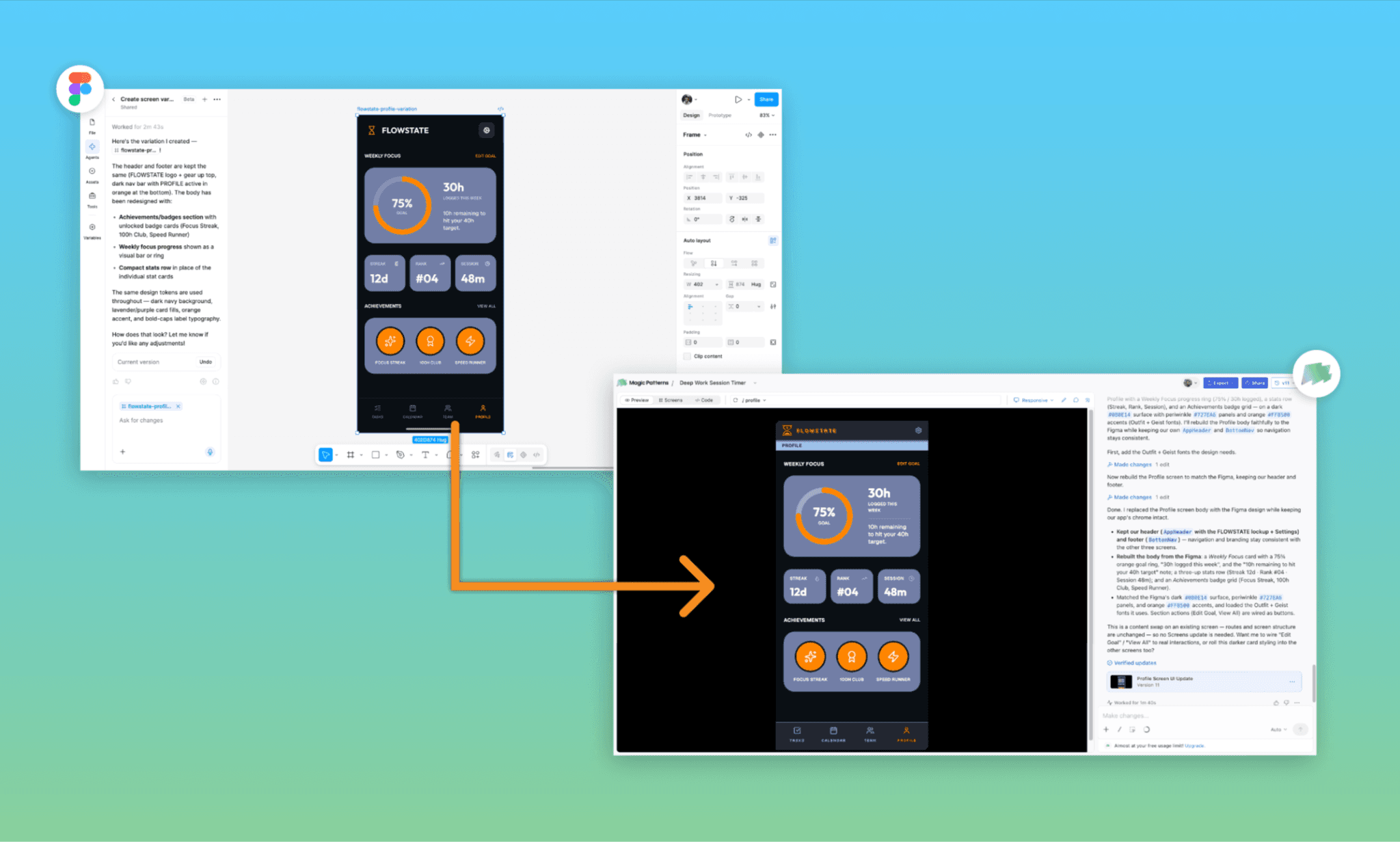
The process is fast (2 mins) but expensive (52 credits), and the output is near-identical.
Code export & MCP

Magic Patterns AI design tool doubles up as a design-to-code AI with its powerful code export features: Sync straight to GitHub, download a full Vite project as a .zip, or copy the code as a single prompt block — all free, and no credits consumed! I found the code genuinely clean with proper component splitting and design tokens; not throwaway markup.
However, for non-tech product builders, it doesn't offer a plain HTML/CSS export option (unlike its peer Banani AI). You need Magic Patterns MCP for that, which only comes in paid plans.
Magic Patterns Chrome Extension
Lastly, checking out the most popular use case of Magic Patterns, turn any screenshot into an editable UI using a Chrome extension. It’s a free tool by them, easy to install, but in my experience, not so easy to use.
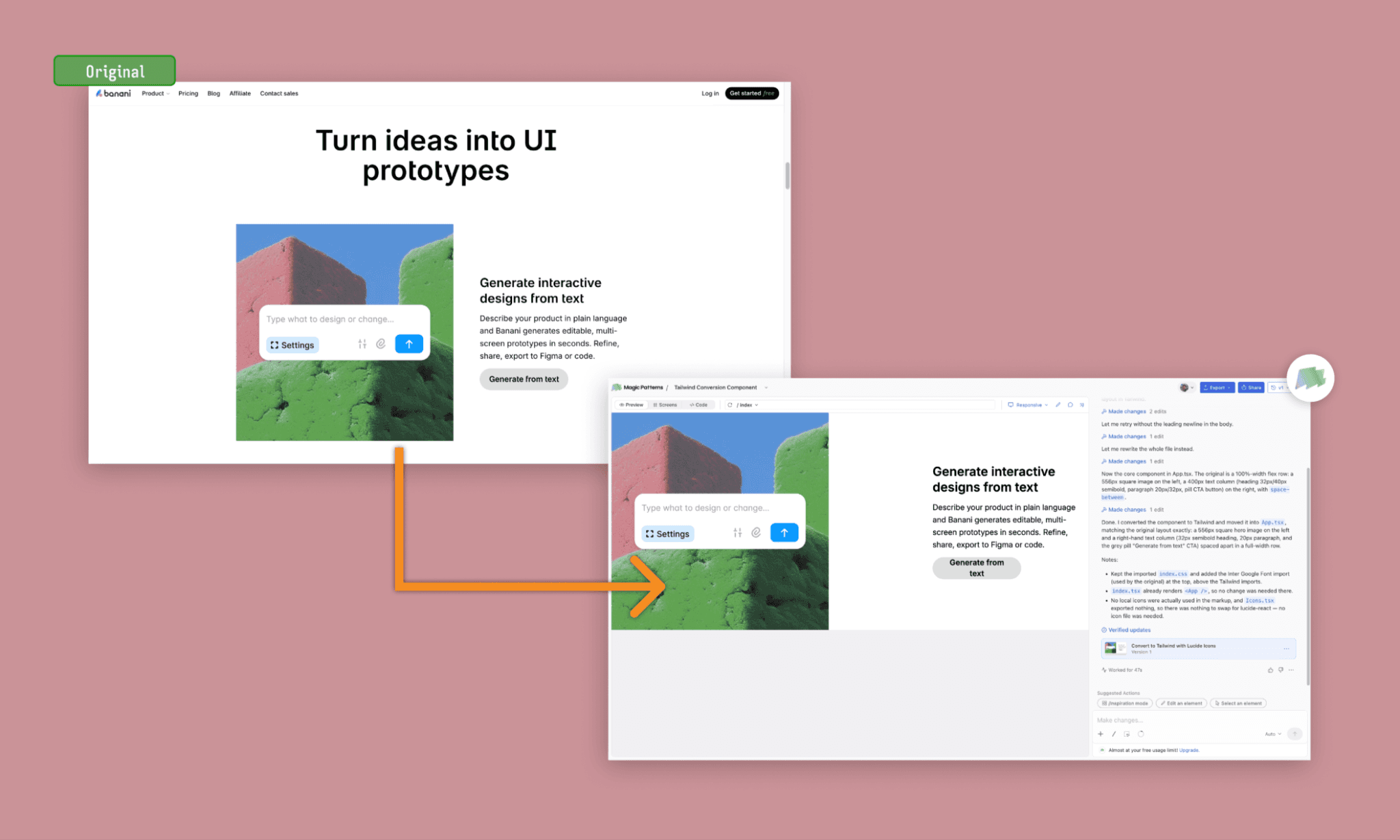
Because instead of replicating the full screen or selecting an area, it asks to hover over certain components that it recognizes from shared divs. Not very convenient (especially in comparison to similar extensions by its competitors, viz. Visily & MagicPath). And even the regeneration has imperfection while it costs you some credits (15 credits in my experiment above).
Pros & Cons of Magic Patterns
Pros | Cons |
Free sign-up, no credit card required to start building | Responsive preview struggles switching between desktop and mobile views |
Produces clean, minimalist prototypes with genuine micro-interactions built in | Interactive elements like dropdowns and toggles sometimes don't function |
Visual edit mode feels Figma-like and costs zero credits | AI edits burn disproportionate credits even for small header changes |
Exports clean, production-ready code with proper component splitting | No plain HTML/CSS export; MCP access requires a paid plan |
Free code export via GitHub sync, zip download, or prompt | Chrome extension is clunky, forces hovering over recognized components only |
Closely followed our custom design system across a multi-screen build | Image-to-Figma conversion is costly for a near-identical design output |
Pros & Cons of MagicPath 2.0 >
2026 Pricing of Magic Patterns
Magic Patterns Free Plan
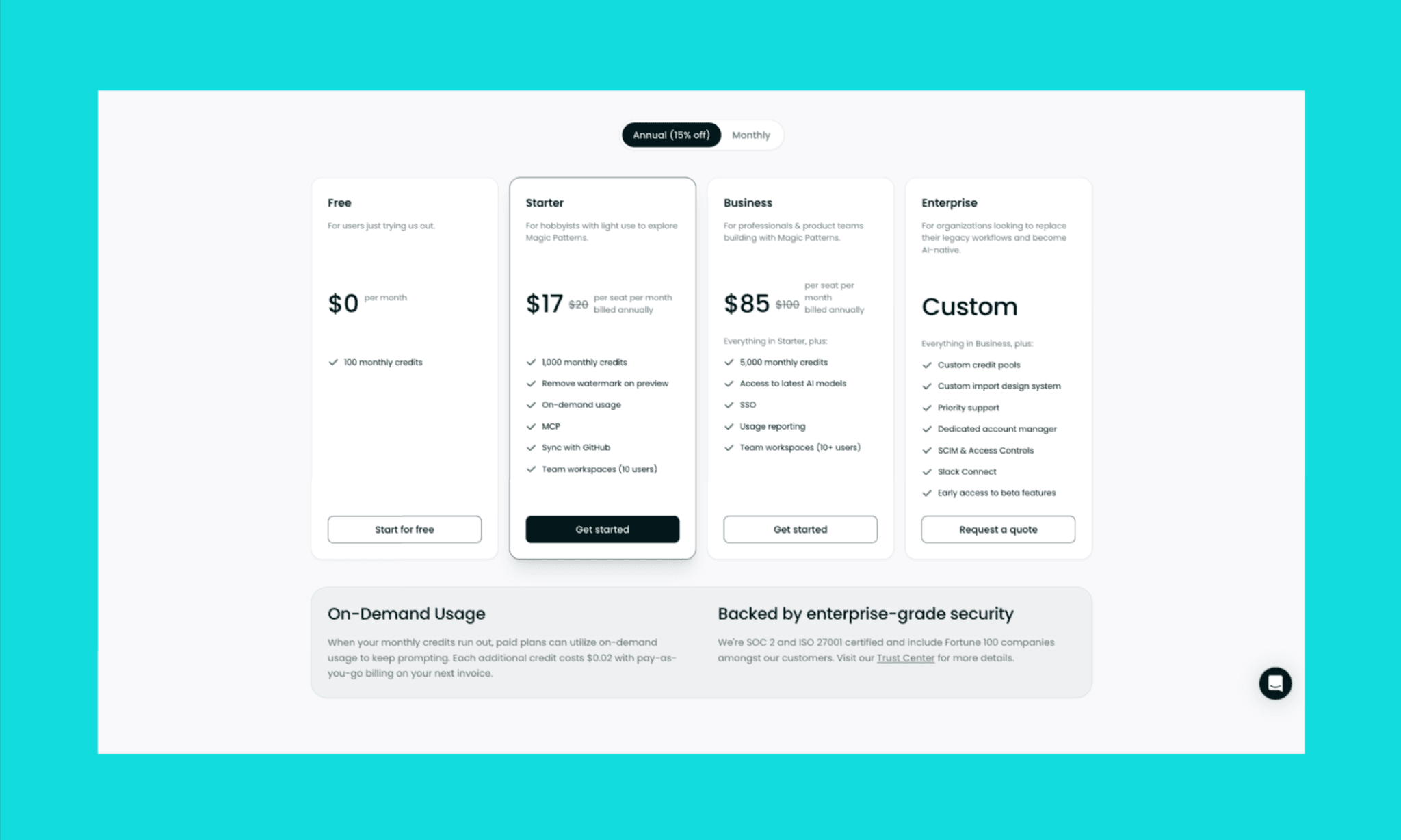
Magic Patterns' Free tier offers 100 monthly credits to explore the tool. You can use all its key generation and editing features, import-export from Figma, and get code as well. I’d say pretty generous to test workflows before committing to a paid workspace.
Magic Patterns Paid Plans
Plan | Price | Monthly AI Credits | Key Features |
Starter | $20/seat/mo | 1,000 | Everything in Free, plus MCP, GitHub, and Figma export; design systems; on-demand usage |
Business | $100/seat/mo (or $85/seat/mo annually) | 5,000 | Everything in Starter, plus SSO, usage reporting, faster AI models, and 10+ user shared workspaces |
*Note: The annual subscription to a Magic Patterns plan is ~17% cheaper
Magic Patterns also offers a bespoke Enterprise Plan at custom pricing. On top of the tool’s Business plan features, they get priority support, shared credit pooling, SCIM & audit logs, and a dedicated technical account manager.
Compare Cost of Top AI UI Tools in 2026 >
Alternatives to Magic Patterns
Banani vs Magic Patterns
Banani is an AI UI design tool built for rapid text-to-UI generation and end-to-end prototyping; the closest in spirit to Magic Patterns. Its standout is the iterative AI chatbot, UI variations, deep Figma integration, and simple design-to-code workflow.
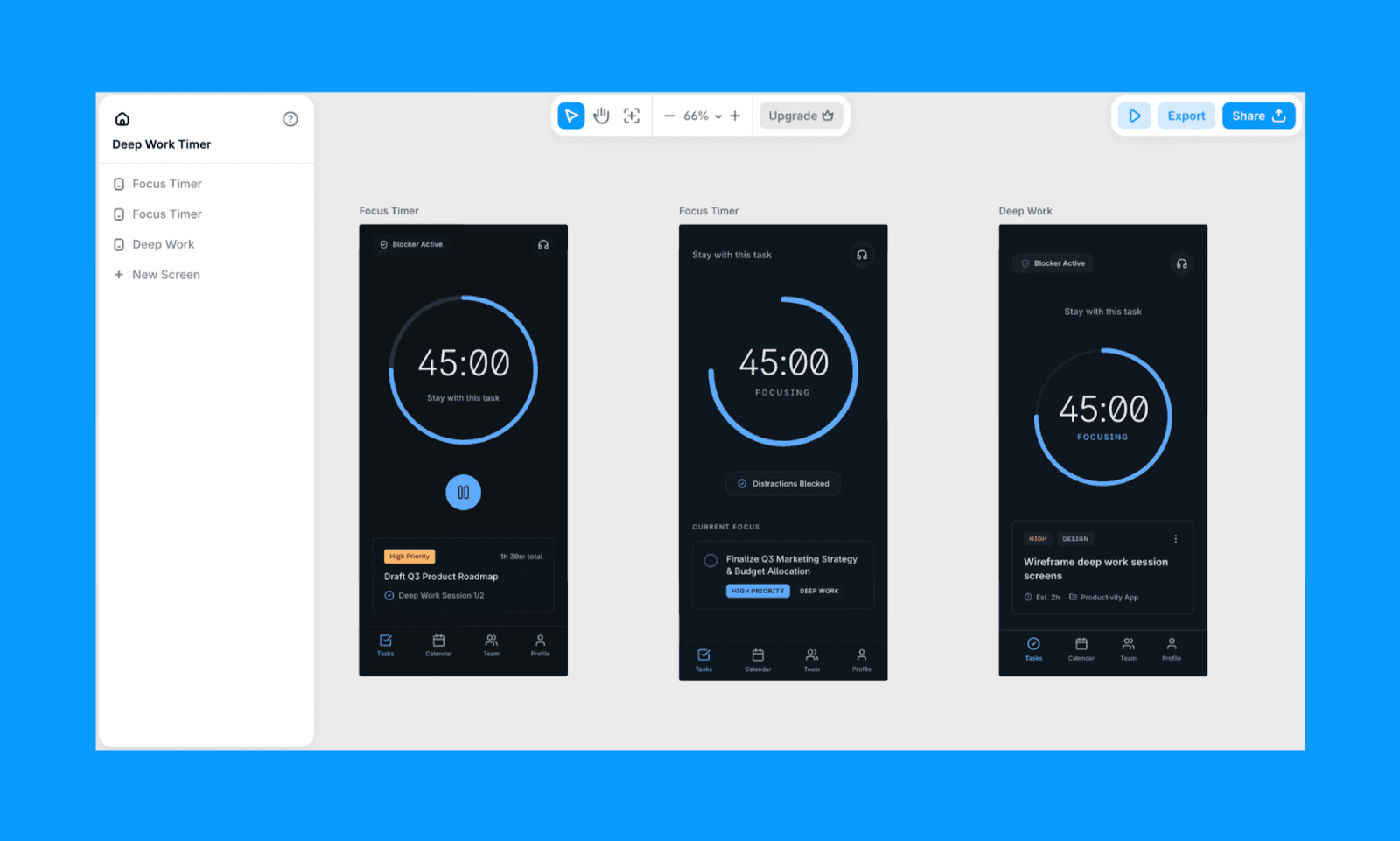
Why choose Banani over Magic Patterns: Better for fast, beautiful designs with easy design-system tweaks.
Try Banani AI UI Designer Free >
Figma Make vs Magic Patterns
Figma Make is an AI layer built directly into Figma, generating UI screens from prompts without leaving the design environment. It's built for teams who prioritize design-system consistency over instant code export, using native Figma dev handoff.
Since Config 2026, Figma Agent has emerged as another suitable substitute for Magic Patterns in the Figma AI ecosystem.
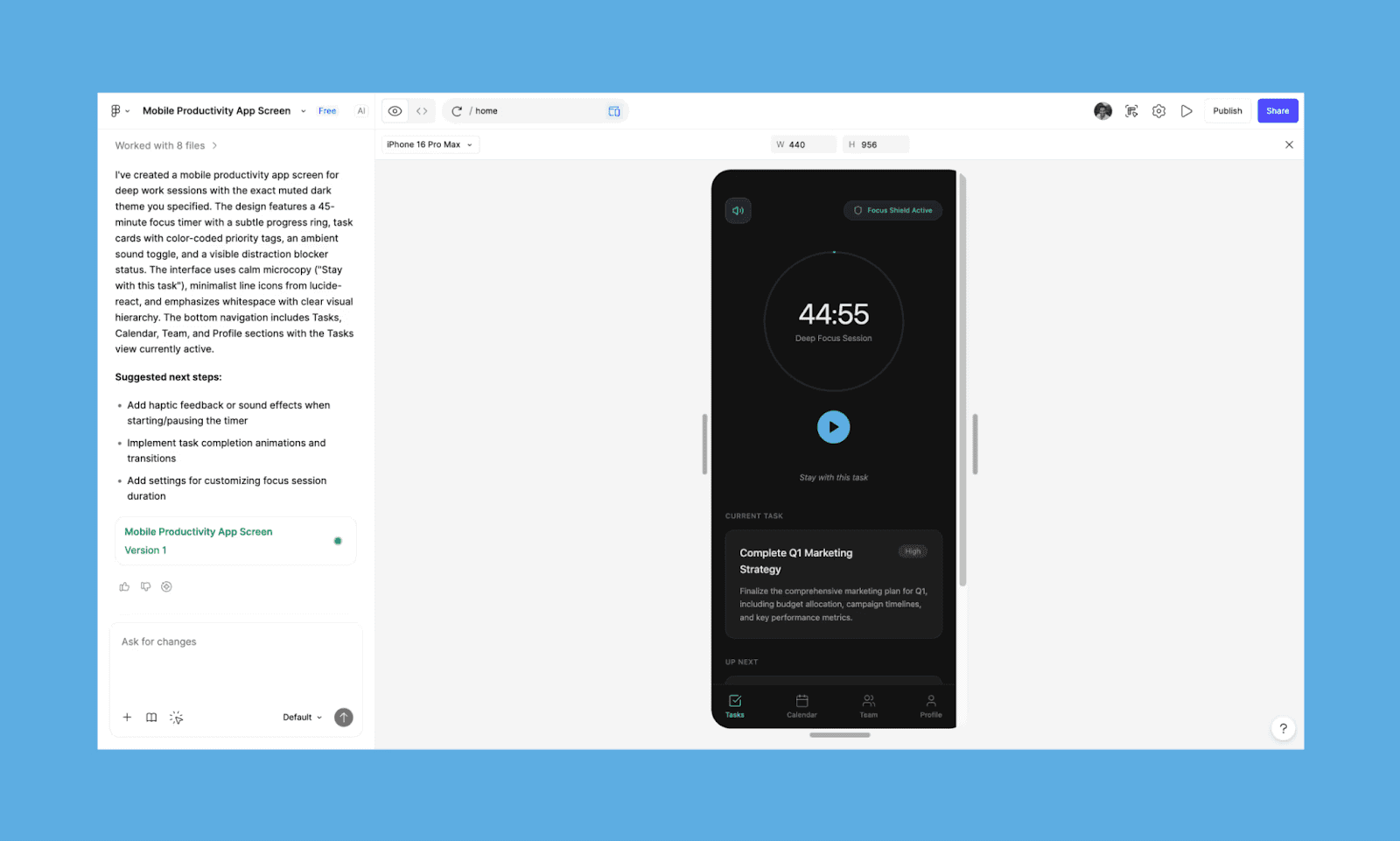
Why choose Figma Make over Magic Patterns: No-brainer for cross-functional product teams already living inside Figma.
How to Use Figma Make for App & Code >
Lovable vs Magic Patterns
Lovable is a vibe-coding AI that builds full-stack apps from prompts, backend logic, and deployment included. Unlike Magic Patterns' UI-first approach, it's built for shipping working products rather than just prototyping interfaces.
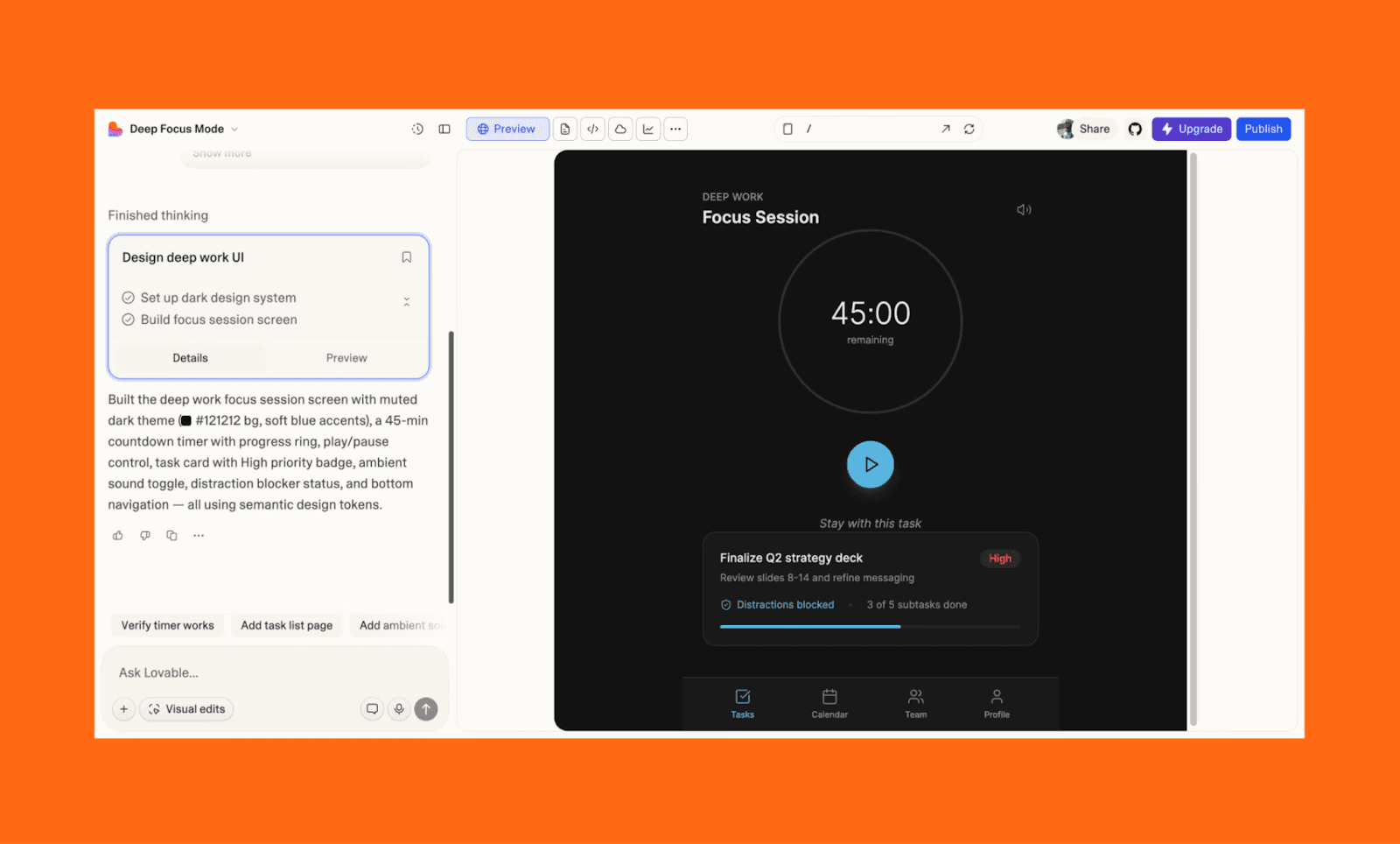
Why choose Lovable over Magic Patterns: Better for building a functional MVP to prove concepts to stakeholders.
Full Comparison of Magic Patterns Alternatives >
Verdict: Is Magic Patterns Worth it?
Per my review of Magic Patterns, it really is magical at delivering on its promises, but the spell loosens as the reality of credit costs hits. I was happy with its design-system fidelity across multi-screen builds, production-ready React code, MCP, and its smooth Figma handoff. But even small AI edits burn credits as if generating a whole screen concerned me with its ROI.
If you want faster iteration without babysitting credit spend, Banani's chatbot-refined workflow gets you to a polished design without the same cost anxiety on every tweak.
FAQs on Magic Patterns AI Design Tool
How to use Magic Patterns?
Like all other AI UI tools in 2026, to use Magic Patterns, you simply sign up (it’s free), then describe your idea (as text, image, or Figma frame), and Go. Their Magic Patterns AI Agent does it magic and turns your prompt into an edible UI/prototype.
Does Magic Patterns have MCP?
Yes, Magic Patterns has an MCP that connects to AI coding agents like Claude Code. This is only available on paid plans (Starter and above).
Is Magic Patterns free?
Magic Patterns is free to test out with 100 AI credits per month. It is enough to test prompt-to-UI generation and visual edits, though heavier multi-screen builds burn through credits fast.
How much does Magic Patterns cost?
Magic Patterns has a freemium model; their paid plans start at $20/seat/month (Starter, 1,000 credits), scaling to $100/seat/month (Business, 5,000 credits).
What is the difference between Figma and Magic Patterns?
Figma is a manual design tool with an AI layer (Figma Make) bolted on; Magic Patterns is AI-native from the ground up, generating full multi-screen prototypes and production code directly from prompts.
Read Figma vs Penpot | Read Figma vs Canva
Which is the best alternative to Magic Patterns?
Banani AI, hands down. For teams that want fast, polished UI generation with an iterative AI chatbot, it is the strongest all-around pick. You can start off with ~ 100 free monthly credits, which consume 2-3 credits per screen.
References
[1] https://www.magicpatterns.com
[2] https://www.linkedin.com/company/magicpatterns
[3] https://www.figma.com/community/plugin/1304255855834420274


